
 Orthodoxy in America
 What is the Orthodox Church?
For a series of introductory articles on the Orthodox Christian Faith, click here.
Question and Answer series with Fr. Justin Frederick.
The Orthodox Church was established on the Day of Pentecost when the Holy Spirit was poured out upon Christ's Apostles in the upper room in Jerusalem. Taking Christ's Gospel from thence, they established His Church throughout the Roman Empire and beyond.
Thus founded by Christ and His Apostles, the Orthodox Church continues to this day in accordance with Christ's word that "the gates of hell" should not prevail against His Church. The Church continues to hold faithfully to the Apostolic Tradition in accordance with the command of St. Paul: "Therefore, brethren, stand fast, and hold the traditions which ye have been taught, whether by word or by our epistle" (2 Thessalonians 2:15), not adding or subtracting from the deposit of Faith to accord with contemporary fads or fashions, for ultimately, the Truth of the Christian Faith is a person, the God-man Jesus Christ, who changes not, and whom Orthodox Christians worship and adore.
Christ Himself is Head of the Orthodox Church. His will is expressed first through the Scriptures (the Bible), which were written by the Prophets and Apostles inspired by Holy Spirit and which were recieved by the Church as being accordance with the Apostolic teaching and proclamation of the Gospel. His will is also expressed through the decisons of the Seven Ecumenical Councils, which were called to settle important matters of Christian faith and practice, and through the living Tradition of the Church.
The local Orthodox Church is headed by a bishop who oversees and governs the parishes in a particular geographical region. He is in communion with and accountable to other bishops, usually those whose territories (dioceses) lie in the same country. They meet in council at least twice a year to decide matters of mutual concern. Thus, the Orthodox Church in the modern world is generally known in its various national manifestations--Greek, Russian, Syrian, Serbian, Romanian, Japanese, Bulgarian, American, Macedonian, Georgian, Lebanese, Ukrainian, etc.--though all share the common faith of Christ's One Church.
The bulk of the early undivided Church, represented by four of the five ancient patriarchates--Alexandria, Antioch, Jerusalem, and Constantinople--lay in the eastern half of the Roman Empire. The western part of the Church, centered in Rome, was staunchly faithful to the Apostolic Faith in the first few centuries, but then gradually drifted away from the rest of the Church, first being politically separated through Barbarian invasions in the West and then theologically deviating from the Church's Apostolic Tradition by changing the Nicene Creed, which the undivided Church had proclaimed was never to be changed. This deviation and others were clearly exposed in 1054 when Rome was formally separated from the rest of the Church, and since then, new Roman dogmas and practices have increased the degree of separation. Reaction in the West to Roman departures from the Apostolic Faith led to the creation of a multitude of Protestant churches in opposition to Rome and to one another through the Protestant Reformation without a full recovery of the fullness of the Apostolic Faith. Thus, the Orthodox Church is in Communion neither with Rome nor the various Protestant churches because of their various deviations from the Faith taught by the Apostles.
Why Do Orthodox Christians...?The original Nicene Creed, composed at the first two Ecumenical Councils in the fourth century and used in the Church to this day, expresses the essential teaching of the Orthodox Church. The heart of this teaching is that the eternal Son of the eternal Father became man in the person of Jesus Christ while remaining fully God in order to reveal God to man and unite man To God. He did this through His birth, life, death on the Cross, Resurrection, and Ascension into Heaven.
Orthodox Christians follow the ancient forms of Christian worship, which are rooted in the Jewish Synagogue and Temple, and their services are full of Scripture. The services are entirely sung or chanted, never read in a conversational tone. The worship is wholistic, addressing and involving the whole person including the mind, the body, and all the senses: sight, hearing, smell, taste, touch.
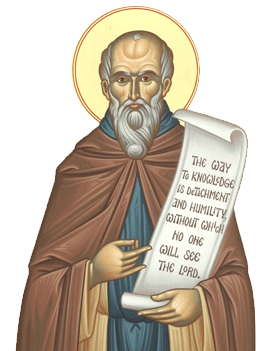
Icons adorning the iconostasis and the walls of the church affirm the reality of Christ's Incarnation--that the eternal Son of God became fully man while remaining fully God. As man, He was visible and revealed the invisible Father to man. (As He said to Philip, "If you've seen Me, you've seen the Father.") The icons of Mary, His mother, the Theotokos ("God-bearer") always include her Son to proclaim the reality of the Incarnation and man's need to participate in his salvation by feely saying "yes" to God as Mary did. The icons of the saints reveal how sinful humans become holy and become conformed to the image of Christ and partakers of the divine nature (2 Peter 1:4). Christ shows through His saints what each Christian is to become--holy bearers of Christ in a fallen world.
Incense is part of man's offering to God as it was in the Old Testament. It indicates the presence of the Holy Spirit in the Church and reminds worshippers that God receives their true prayer as a sweet fragrance (Revelation 8:3-4).
Orthodox Christians worship standing for three reasons: out of respect for Christ the King, as a sign of the Resurrection (Christ has raised us up with Himself), and because worship is properly an active work of the people, not passive listening or entertainment.
Candles used in Orthodox worship represent the light of Christ that each Christian is to shine in the world and the warmth of zeal for the Faith and of love for God and man that must burn in the heart of each believer, who is called to walk in the Light of Christ rather than darkness and to be hot towards God rather than cold or lukewarm. The candle also represents an offering to God, showing that in true worship we offer ourselves to Him as living sacrifices. Orthodox prayer is always offered with burning open flame.
Orthodox Christians often make the sign of the Cross, especially when the Holy Trinity is mentioned. The index and middle fingers of the right hand are pressed against the thumb, and the two little fingers are pressed against the palm. With the hand held in this fashion, the worshipper touches head, stomach, right shoulder, and left shoulder, and then bows. Making the sign of the Cross in this way confesses the Orthodox Christian's faith in the Holy Trinity (3 fingers) and Christ's incarnation in two natures (2 fingers) as perfect God and perfect man.
Orthodox priests are usually married in accordance with ancient practice.
The Eucharist (Holy Communion) is reserved for Orthodox Christians who have properly prepared themselves through prayer, fasting, and a recent confession with a priest. Apart from Communion, visitors and unprepared Orthodox are welcome to participate fully in Orthodox worship.
Orthodox Prayer BookThe prayers from a standard Orthodox Prayer Book now out of print and edited to reflect local parish translations.
Morning-Prayers.pdf Standard collection of morning prayers.
Little-Compline.pdf The "After Dinner" service of the Church; used by many as their evening prayer. Used extensively in the Greek Church with the Akathist to the Theotokos as regular evening prayer.
Prayers-Before-Sleep.pdf Standard collection of evening prayers used most frequently among the Slavs.
The-Three-Canons.pdf Used in preparation for Holy Communion, for Confession, or as needed or desired.
PreCommunion-Prayers.pdf Prayers in preparation to receive Holy Communion.